


Summary
DIFC and ADGM are the UAE’s two financial free zones, both built on English common law with their own courts and independent regulators. DIFC in Dubai is larger, with over 10,000 active companies and the DFSA as regulator. ADGM in Abu Dhabi offers direct English law, the FSRA’s RegLab and reduced non-financial licence fees. Your licence type, budget and city should decide.
When a fund manager, fintech founder or family office asks me where to set up in the UAE, the shortlist almost always comes down to two names: DIFC or ADGM. Both are serious international financial centres. Both are trusted by global banks. And both will happily take your application.
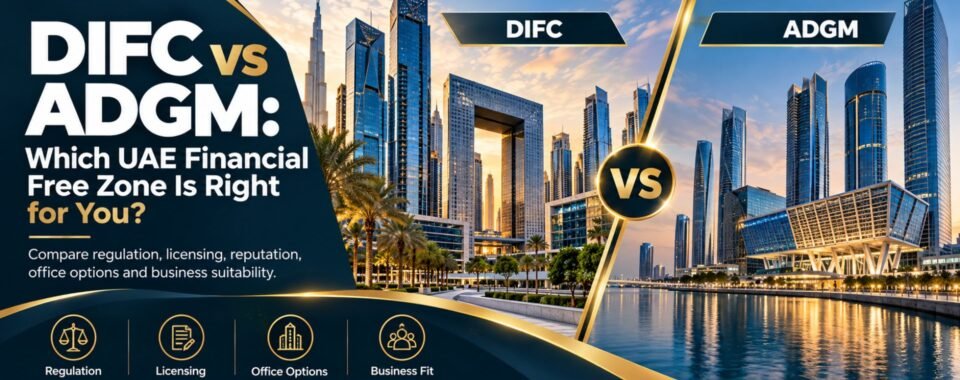
So the real question is not which one is “better” in general. It is which one fits your activity, your regulator relationship, your team’s base city and your long-term structure. This DIFC vs ADGM comparison walks through each factor using official figures, so you can make that call with confidence.
DIFC vs ADGM: What They Have in Common (and Where They Differ)
Before the differences, it helps to see how much these two financial centres share.
What they have in common:
- Both are financial free zones with their own civil and commercial laws, separate from onshore UAE law
- Both run independent, English-language common law courts
- Both have an independent financial regulator that licenses banks, asset managers, brokers and fintech firms
- Both allow 100% foreign ownership and offer company structures such as private companies, SPVs and foundations
Where they differ, at a glance:
| Factor | DIFC | ADGM |
|---|---|---|
| Emirate | Dubai | Abu Dhabi |
| Established | 2004 | Courts and laws in place from 2015 |
| Financial regulator | Dubai Financial Services Authority (DFSA) | Financial Services Regulatory Authority (FSRA) |
| Legal approach | Own codified laws on an English common law framework | Direct application of English common law |
| Scale (H1 figures) | 10,018 active registered companies | 13,974 active licences, 3,986 operational entities |
| Innovation route | DIFC Innovation Hub and Innovation Licence | FSRA RegLab sandbox and Tech Startup licence |
| Location | DIFC district, Sheikh Zayed Road | Al Maryah Island and Al Reem Island |
Note that DIFC counts “active registered companies” while ADGM reports “active licences” and “operational entities”. These are different measures, so compare them with care.
Legal Framework: DIFC Courts vs ADGM Courts
This is the section lawyers love, and it matters more than most founders expect.
ADGM is the first jurisdiction in the Middle East to apply English common law directly, through the Application of English Law Regulations 2015. ADGM describes this as an approach similar to Singapore and Hong Kong. Its ADGM Courts have a Court of First Instance (with commercial, real property, employment and small claims divisions) and a Court of Appeal.
DIFC has its own body of civil and commercial laws based on an English common law framework. The DIFC Courts are an English-language common law commercial court. A key strength is the opt-in route: parties anywhere can choose DIFC Courts jurisdiction in their contracts, with no mandatory UAE connection. In the first half of 2026, the Dubai Media Office reported 243 opt-in cases out of 810 total.
Practical takeaway: if your investors or counterparties are used to English law and you want it applied as directly as possible, ADGM has an edge. If you want a court with a long track record and wide use in regional commercial contracts, DIFC Courts are very well established.
Regulatory: DFSA (DIFC) vs FSRA (ADGM): Which Is Better?
Neither regulator is “better”. Both follow international standards and both are respected by global institutions. The difference is in focus and process.
DFSA (DIFC)
- Regulates banks, insurers, asset managers, brokers and other financial firms in DIFC
- Oversees a deep financial community of 1,134 regulated firms, as of H1 2026
- Suits firms that want access to Dubai’s large banking, insurance and wealth market
FSRA (ADGM)
- Licenses and supervises financial services in ADGM
- Runs the FinTech RegLab, launched in November 2016 as a regulatory sandbox where firms can test products for up to two years
- Granted 45 financial services permissions in H1 2026, per Abu Dhabi Media Office
My advice: speak to both regulators early if your activity is regulated. Your application quality, compliance team and capital readiness affect approval time far more than which authority you choose.
Business Activities: What Each Zone Specialises In
Both centres host banking, asset management, insurance and fintech. Their strengths still lean differently.
DIFC is strongest in:
- Banking and capital markets (327 firms, H1 2026)
- Wealth and asset management (592 firms)
- Insurance and reinsurance (165 entities)
- Family business and foundations (1,409 foundations, up 67% year on year)
- AI, FinTech and innovation (1,933 firms)
These figures come from DIFC’s own H1 2026 results.
ADGM is strongest in:
- Fund and asset management, with 190 asset managers running 276 funds in H1 2026
- Fintech and virtual asset businesses tested through RegLab
- Proximity to Abu Dhabi’s sovereign wealth funds and institutional capital
For non-financial activities such as holding companies, consulting and tech, both zones work well, and pricing often becomes the deciding factor.
Cost: DIFC vs ADGM Formation and Annual Fees
Cost in a financial free zone has three layers: the commercial licence or registration fee, the regulator’s authorisation fees (for regulated firms) and your office, visa and compliance spend. The last layer is usually the largest.
ADGM official commercial licence fees (in force since 1 January 2025, per ADGM):
| ADGM category | New registration | Annual renewal |
|---|---|---|
| Non-financial | USD 5,500 | USD 5,000 |
| Retail | USD 2,500 | USD 2,000 |
| Financial | USD 16,700 | USD 16,200 |
| Tech startup | USD 1,500 | USD 1,500 |
A USD 300 data protection fee is added at registration and each renewal.
DIFC fees. The DIFC Innovation Licence costs USD 1,500 per year and is subsidised for 2 to 5 years, with access to co-working space and discounted visas. Fees for other DIFC company types are set out in DIFC’s official handbooks, and you should request the current schedule for your exact structure. For a detailed breakdown, read our guide on how much it costs to set up a business in DIFC.
Costs people forget:
- Office lease, since regulated firms usually need physical premises
- Regulator application and annual supervision fees
- Audited financial statements and compliance officer costs
- Visas, Emirates ID and medical tests for each employee
Tax note: DIFC and ADGM companies fall under UAE corporate tax. A company may access the 0% rate on qualifying income only if it meets the Qualifying Free Zone Person conditions in the Federal Tax Authority guide. Other taxable income is taxed at 9%.
Location: Dubai Financial Centre vs Al Maryah Island Abu Dhabi
Location shapes hiring, client access and daily life.
DIFC spans 110 acres off Sheikh Zayed Road in Dubai, and DIFC reports 1.45 million square feet of office space. It is surrounded by Dubai’s banking, legal and advisory community, with easy access to Dubai International Airport. DIFC is also expanding through the new DIFC Zabeel District.
ADGM sits on Al Maryah Island and Al Reem Island in Abu Dhabi, the UAE capital. It is close to sovereign wealth funds and government-related investors, which is a real draw for fund managers. ADGM reported a workforce of 49,027 professionals in H1 2026.
Talent tip: Dubai has the larger pool of finance professionals, while many firms find Abu Dhabi offers a calmer base close to institutional capital. Ask where your first five hires will live before you sign a lease.
Which to Choose: Financial Services Decision Guide
Here is how I guide clients through the final decision.
Choose DIFC if you are:
- A bank, insurer, broker or wealth manager targeting Dubai’s private clients
- A family office or business family setting up a DIFC foundation or holding structure
- A fintech or AI startup wanting the Innovation Licence and Dubai’s investor network
- A business that wants DIFC Courts in its contracts across the region
Choose ADGM if you are:
- A fund or asset manager seeking Abu Dhabi institutional capital
- A fintech or virtual asset firm that wants to test in the FSRA RegLab
- A holding company or SPV owner who wants direct English common law
- A non-financial or retail business that benefits from ADGM’s reduced licence fees
Not a financial firm at all? You may not need a financial free zone. Compare general options in our DMCC free zone guide and our overview of the cost of a trade license in Dubai. When you are ready, our team can map both routes for you as part of a complete business setup in Dubai plan.
After incorporation, keep your UAE company registration number and licence details handy, as banks and regulators will ask for them repeatedly.
FAQs
Is DIFC or ADGM better for fintech?
Both are strong. ADGM’s FSRA RegLab lets fintech firms test products in a sandbox for up to two years. DIFC offers the Innovation Licence at USD 1,500 a year and a community of 1,933 AI, FinTech and innovation firms. Choose based on your regulator fit and target market.
Do DIFC and ADGM both use English common law?
Yes, in different ways. ADGM applies English common law directly under the Application of English Law Regulations 2015. DIFC has its own civil and commercial laws built on an English common law framework.
Which is cheaper, DIFC or ADGM?
For innovation and tech startups, both list a USD 1,500 yearly licence. ADGM has published reduced non-financial and retail fees. For regulated firms, office, staff and compliance costs usually outweigh the licence fee in either zone.
Who regulates DIFC and ADGM?
The Dubai Financial Services Authority (DFSA) regulates financial services in DIFC. The Financial Services Regulatory Authority (FSRA) regulates financial services in ADGM.
Can a company outside DIFC use the DIFC Courts?
Yes. Parties to qualifying civil and commercial disputes can opt in to DIFC Courts jurisdiction by contract, with no mandatory UAE connection.
Is DIFC or ADGM better for a foundation or family office?
Both offer foundation regimes. DIFC is home to 1,409 foundations as of H1 2026, while ADGM’s direct English law appeals to families used to English trust and estate concepts. A legal adviser should review your succession goals before you choose.
Do DIFC and ADGM companies pay corporate tax?
They are within the UAE corporate tax system. The 0% rate applies only to qualifying income for companies meeting the Qualifying Free Zone Person conditions. Other taxable income is taxed at 9%.