




By Adil Ahmad, Business Setup Consultant at Gulf Corporate Services
Summary
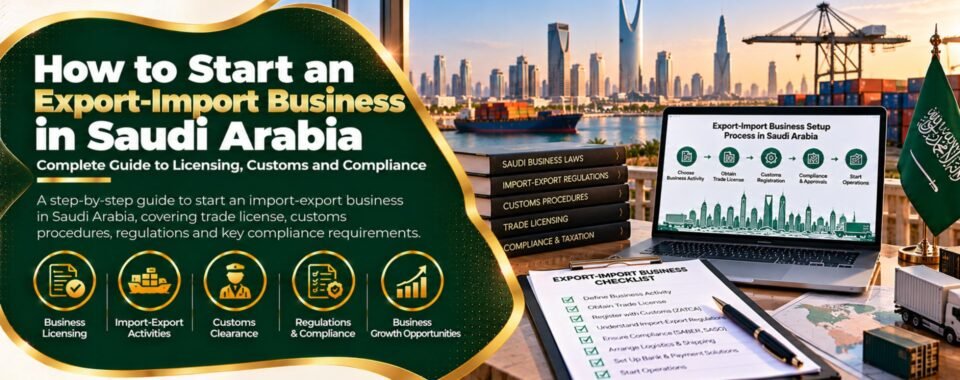
To start an export import business in Saudi Arabia, you need a company with a Commercial Registration covering import or export, a MISA licence if foreign shareholders are involved, ZATCA customs and VAT registration, and product approvals through SABER or SFDA. The right structure depends on your ownership, capital and target market. This guide covers licences, structures, steps, costs, duties and FAQs.
Why Start an Import Export Business in Saudi Arabia?
Saudi Arabia is the largest economy in the Gulf and a major importer of consumer goods, machinery, building materials, food and electronics. Vision 2030 also pushes non-oil exports, so the government supports companies that trade Saudi products abroad.
Key reasons investors choose an import export business in Saudi Arabia:
- Large, young consumer market with strong demand for food, fashion, electronics and home goods
- Giga projects and construction driving imports of equipment, materials and technology
- Gateway location between Asia, Africa and Europe, with Red Sea and Gulf ports
- GCC Customs Union, which allows goods of GCC origin to move between member states without customs duty
- Export support from the Saudi Export Development Authority and the Saudi EXIM Bank
The market is attractive but regulated, so plan your structure before your first order.
Import Export Business Models
| Model | How It Works | Best For |
|---|---|---|
| Importer and distributor | Buy from overseas suppliers and sell to retailers or projects | Consumer goods, food, building materials |
| Wholesale trading | Hold stock and supply other businesses in bulk | Established traders with warehouse space |
| E-commerce importer | Import and sell online to consumers | Fashion, beauty, gadgets |
| Exporter | Sell Saudi made products to foreign buyers | Food, petrochemical derivatives, dates, plastics |
| Re-export and logistics | Consolidate goods and ship across the GCC and Africa | Traders near ports and free zones |
| Sourcing agent | Source goods from China, India or Turkey for Saudi buyers on commission | Founders with supplier networks |
Many founders begin by importing from China, India or Turkey, then add export lines once they understand Saudi customs and buyers.
Licences You Need for an Import Export Business
1. MISA Investment Licence
Any company with foreign shareholders needs an investment licence from the Ministry of Investment of Saudi Arabia (MISA). MISA replaced SAGIA, so older guides using the SAGIA name are out of date. Read our guide to the MISA license for the full process.
2. Commercial Registration (CR)
The CR, issued through the Ministry of Commerce and the Saudi Business Center, must list import, export or trading activities. Under the Commercial Register Law that took effect in 2025, CRs no longer need annual renewal. Instead, companies confirm their data each year, and each company has one national CR. See our guides to the trade license in Saudi Arabia and the commercial license.
3. ZATCA Customs and VAT Registration
Importers and exporters register with the Zakat, Tax and Customs Authority (ZATCA) and use the Fasah platform for customs declarations. Import VAT at 15% is collected at the border.
4. Product Approvals
- SABER (SASO): regulated consumer and industrial products need a Product Certificate of Conformity and a Shipment Certificate of Conformity through SABER
- SFDA: food, cosmetics, medical devices and medicines need approval from the Saudi Food and Drug Authority. See our guide to food import approval in Saudi Arabia
- Other regulators: telecom equipment, chemicals and some agricultural goods need further permits
5. Export Documents
Exporters usually need a certificate of origin from the Chamber of Commerce, plus any buyer country approvals. Our guide on how to obtain an export license in Saudi Arabia covers this in detail.
Best Business Structure for an Import Export Company
Your structure decides how much capital you need, who can own the company and whether you can trade directly.
| Structure | Ownership | Key Points |
|---|---|---|
| Saudi owned LLC | Saudi or GCC nationals | Simplest route for trading, lower capital |
| Foreign owned trading LLC | Up to 100% foreign | Needs a MISA trading licence with high capital and international presence conditions |
| Joint venture with a Saudi partner | Shared | Often lowers the barrier for trading activities |
| Branch of a foreign company | 100% parent owned | Parent stays liable, suits established groups |
| Regional headquarters | Foreign group | For multinationals managing the region, with limits on direct trading |
| GCC national company branch | GCC company | For companies already set up in the UAE or another GCC state |
An important point on capital: foreign owned trading companies have historically needed share capital of around SAR 30 million under MISA’s trading conditions, along with presence in several international markets. Reports in 2026 indicate MISA now allows flexible capital plans based on a five year business plan. Confirm the current conditions with MISA before you budget, because this is the single biggest factor in your setup cost.
If you want to keep investment capital separate from trading risk, many groups hold shares through a parent or holding company abroad and capitalise the Saudi entity only to the level the licence requires. Compare the options in our guides to LLC company formation in Saudi Arabia, a branch of an international company, a GCC national branch company and the regional headquarters license.
Importing From China to Saudi Arabia
China is Saudi Arabia’s largest trading partner, and many new importers start there. Before ordering, check:
- Whether each product needs SABER certificates before shipping
- Arabic labelling and product marking rules
- The correct HS code, since it sets your duty rate
- Supplier quality control and factory audits
- Shipping terms (FOB or CIF) and who pays insurance
How to Start an Export Import Business in Saudi Arabia: Step by Step
- Choose your products and markets and check whether they are restricted or regulated.
- Decide your structure: Saudi owned, foreign owned, joint venture or branch.
- Apply for the MISA licence if there are foreign shareholders.
- Reserve a trade name and register the CR with import, export or trading activities.
- Sign the articles of association and deposit capital in a Saudi bank.
- Register with ZATCA for VAT, Zakat or corporate tax, and customs.
- Open a Fasah account linked to your CR.
- Join the Chamber of Commerce and register on Qiwa, GOSI and Muqeem.
- Lease an office or warehouse and obtain municipal permits.
- Get SABER or SFDA approvals for your products.
- Appoint a licensed customs broker and freight forwarder.
- Ship, declare and clear your first consignment.
A Saudi owned trading company can often be ready in two to four weeks. Foreign owned companies usually take two to four months, depending on MISA approval and document attestation. A government relations officer (GRO) can handle many of these steps for you.
Documents Required
- Passport copies of shareholders and managers
- Parent company documents, attested, for corporate shareholders
- Audited financial statements of the parent company, for MISA
- Board resolution and power of attorney
- Articles of association
- Lease contract for office or warehouse
- Product specifications and test reports for SABER or SFDA
For each shipment: commercial invoice, packing list, bill of lading or airway bill, certificate of origin, SABER shipment certificate and any SFDA permits.
Import Export Business Cost in Saudi Arabia
The figures below are approximate market estimates based on recent projects. They exclude regulatory capital and stock. Always confirm current government fees before budgeting.
| Cost Item | Approximate Cost (SAR) |
|---|---|
| MISA licence (where applicable) | Varies; fee relief has applied at times |
| CR and trade name | 1,200 to 2,000 |
| Chamber of Commerce membership | 2,000 to 3,000 per year |
| Legal and formation support | 10,000 to 40,000 |
| Office or warehouse rent | 30,000 to 150,000+ per year |
| Municipal permits | 2,000 to 6,000 |
| SABER certificates | 500 to 5,000 per product |
| Customs broker | 300 to 1,500 per shipment |
| Iqama and work permit per employee | 10,000+ per year |
| Typical Saudi owned setup, excluding stock | 50,000 to 200,000 |
For a full breakdown, read how much it costs to set up a business in Saudi Arabia.
Customs Duties and Clearance
- Customs duty: many goods attract a 5% duty on the CIF value under the GCC common tariff, while some categories carry higher rates. Your HS code decides the rate.
- Import VAT: 15% on the customs value plus duty.
- GCC origin goods: generally free of customs duty within the GCC Customs Union, with a valid certificate of origin.
- Clearance: with complete documents, many shipments clear in one to five working days.
Worked example: goods with a CIF value of SAR 100,000 at 5% duty pay SAR 5,000 in duty, then 15% VAT on SAR 105,000, or SAR 15,750. Import VAT can usually be recovered if you are VAT registered.
For step by step customs guidance, see our guide to importing goods to Saudi Arabia.
Tax and Saudization
- VAT: 15% standard rate, with mandatory registration once taxable supplies pass SAR 375,000 a year
- Corporate income tax: 20% on the foreign share of profits
- Zakat: 2.5% on the Saudi and GCC share of the Zakat base
- Saudization (Nitaqat): trading companies must hire a set share of Saudi nationals, tracked through Qiwa. Read about Saudi labour laws for expatriates
Common Mistakes to Avoid
- Ordering stock before checking SABER or SFDA requirements
- Using the wrong HS code and paying the wrong duty
- Choosing a foreign owned structure without budgeting for trading capital rules
- Missing Arabic labels, which can hold goods at the port
- Ignoring Saudization quotas until visas are blocked
Expert Tip From Our Consultants
Start with one product line and one supplier country, and run a small trial shipment before scaling. Foreign investors should compare a joint venture or GCC company route with a fully foreign owned licence before committing capital. Exporters should register with Saudi Exports early for buyer matching and export finance.
Frequently Asked Questions
Do I need an import license in Saudi Arabia?
Yes. You need a CR with import activity, ZATCA registration and product approvals where required.
Can a foreigner own 100% of an import export company in Saudi Arabia?
Yes, with a MISA licence, but trading activities carry higher capital and experience conditions.
What is the best business structure for import export in Saudi Arabia?
It depends on ownership. Saudi or GCC owned LLCs are simplest, while foreign investors often compare a trading LLC, joint venture or branch.
What is the import duty rate in Saudi Arabia?
Many goods pay 5% on CIF value, while some categories pay more. Import VAT is 15%.
How do I export to Saudi Arabia from the USA or UAE?
You need a Saudi importer of record, SABER or SFDA approvals and correct shipping documents.
What is SABER?
SABER is SASO’s online platform that issues product and shipment conformity certificates.
How long does it take to start an import export business in Saudi Arabia?
About two to four weeks for a Saudi owned company, and two to four months for a foreign owned company.
Start Your Saudi Import Export Business With Expert Support
Gulf Corporate Services helps traders and investors choose the right structure, secure MISA and CR approvals, register with ZATCA and open a corporate bank account. Explore our full business setup in Saudi Arabia services, or speak to our business setup consultants for a free cost estimate.