


By Adil Ahmad, Business Setup Consultant at Gulf Corporate Services
Summary
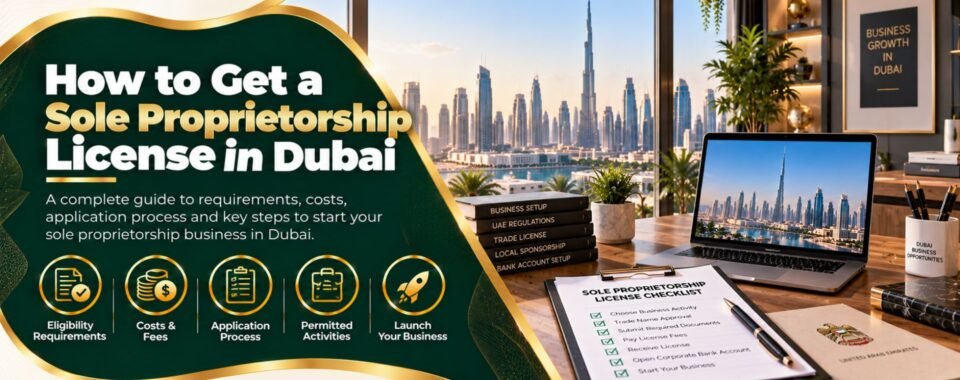
A sole proprietorship in Dubai, officially called a sole establishment, is a mainland business owned by one person who carries unlimited personal liability. Expats can usually own 100% of a professional sole establishment with a Local Service Agent, while trading activities need an LLC. Setup typically costs AED 15,000 to 30,000 in year one. This guide covers eligibility, steps, costs, tax and FAQs.
What Is a Sole Proprietorship in Dubai?
A sole proprietorship, or sole establishment, is the simplest business structure on Dubai mainland. One individual owns the business, trades under a registered trade name and keeps all the profit. The business is not a separate legal entity, so the owner is personally responsible for every debt and obligation.
Key features:
- One owner, who must be a natural person, not a company
- Unlimited liability, so personal assets are at risk if the business cannot pay its debts
- No share capital requirement for most activities
- Licensed by the Department of Economy and Tourism (DET) on Dubai mainland
- Can trade anywhere in Dubai, including with government and private clients
It suits consultants, designers, trainers, engineers, IT specialists and other professionals who want to work under their own name and keep setup simple.
Who Can Open a Sole Proprietorship in Dubai?
| Owner | Professional Activities | Commercial Activities |
|---|---|---|
| UAE national | Yes | Yes |
| GCC national | Yes | Yes, for most activities |
| Expat (foreign national) | Yes, 100% owned, usually with a Local Service Agent | Generally not as a sole establishment. Use an LLC or one person LLC |
The Local Service Agent (LSA)
Expats running a professional sole establishment usually appoint a UAE national as a Local Service Agent. The LSA:
- Holds no ownership and has no share in profits
- Helps with government formalities
- Receives a fixed annual fee, often AED 5,000 to 15,000 depending on the agreement
- Signs an agreement that should state clearly that they have no control over your business
Rules on LSAs have changed in recent years, so confirm the current requirement for your activity with DET before signing anything.
Pros and Cons of a Sole Proprietorship
| Advantages | Disadvantages |
|---|---|
| Simple, fast setup with low paperwork | Unlimited personal liability |
| No share capital for most activities | Trading activities generally not open to expats |
| Full control and 100% of profits | Local Service Agent fee for most expats |
| Can work with any client on Dubai mainland | Harder to bring in partners or investors |
| Lower annual costs than many LLCs | Some banks and large clients prefer LLCs |
For a wider look at ownership rules across the country, the UAE Government’s guide to starting a business is a useful reference.
Sole Proprietorship Business Setup in Other Emirates
The sole establishment structure exists across the UAE, but rules differ by emirate. Abu Dhabi, Sharjah and the northern emirates each have their own economic departments, activity lists and fees. If your clients are mainly outside Dubai, compare local options before you commit, because a Dubai license does not automatically let you open an office in another emirate.
Sole Proprietorship License Types in Dubai
- Professional license: for services based on personal skill, such as consulting, IT, design, engineering, translation, training and medical or legal practice. This is the main route for expats. See our professional licence in Dubai guide.
- Commercial license: for buying and selling goods. Mostly available to UAE and GCC nationals as a sole establishment.
- Industrial license: for small manufacturing, again mostly for UAE and GCC nationals in this structure.
Some activities also need approval from another authority, such as the Dubai Health Authority for healthcare or the Knowledge and Human Development Authority for training.
Sole Proprietorship vs Other Options
| Factor | Sole Establishment | One Person LLC | Freelance Permit | Free Zone FZE |
|---|---|---|---|---|
| Owner | One individual | One individual or company | One individual | One individual or company |
| Liability | Unlimited | Limited to capital | Personal | Limited |
| Trade across Dubai mainland | Yes | Yes | Limited to permit scope | Restricted |
| Trading activities for expats | No | Yes | No | Yes, within the zone |
| Hire staff | Yes | Yes | Usually no | Yes |
| Best for | Professionals and consultants | Founders who want liability protection | Individual freelancers | International and online businesses |
If limited liability matters to you, compare our guide on how to open a one person LLC in Dubai. Solo freelancers can also look at the freelance visa in Dubai, and international founders may prefer free zone company setup.
How to Get a Sole Proprietorship License in Dubai: Step by Step
- Choose your activity from DET’s activity list and confirm it allows a sole establishment for your nationality.
- Reserve a trade name that reflects your activity. Many professionals use their own name.
- Get initial approval from DET through the Invest in Dubai portal.
- Appoint a Local Service Agent if required, and sign the agreement before a notary.
- Get external approvals if your activity needs them.
- Lease an office and register the Ejari. Some small activities can use business centre or instant license options instead.
- Pay the fees and receive your trade license.
- Get your establishment card from immigration.
- Apply for your residence visa as the owner, then visas for any staff.
- Open a corporate bank account and register for corporate tax.
Most sole establishments are licensed within one to two weeks once documents are ready. Visas and banking add a few more weeks.
Documents Required
- Passport copy and passport photo
- UAE residence visa and Emirates ID, if you already live in the UAE
- Trade name reservation and initial approval
- Local Service Agent agreement, if required
- Attested degree or professional certificates for regulated professions
- Office tenancy contract with Ejari
- No objection letter from your current sponsor, if you are employed in the UAE
Cost of a Sole Proprietorship License in Dubai
The figures below are approximate market estimates from recent client projects. Always confirm current fees before you budget.
| Cost Item | Approximate Cost (AED) |
|---|---|
| Trade name reservation | Around 600 to 1,000 |
| Initial approval | Around 100 to 200 |
| DET license fee | 8,000 to 15,000 per year |
| Local Service Agent fee | 5,000 to 15,000 per year |
| Office or business centre with Ejari | 10,000 to 40,000 per year |
| Establishment card | 1,000 to 2,000 |
| Owner residence visa | 4,000 to 7,000 |
| Typical first year total | 15,000 to 30,000, before office and visa |
Renewals are usually lower than the first year. For mainland fees in more detail, see the cost of obtaining a trade license in Dubai and our mainland company formation in Dubai guide. Compare our guides on small business license cost in Dubai and the instant licence in Dubai.
Visas and Hiring Staff
As the owner, you can sponsor your own investor or partner style residence visa through the sole establishment. You can also hire staff:
- Your visa quota depends mainly on your office size
- Employees are registered with the Ministry of Human Resources and Emiratisation (MOHRE)
- Salaries must be paid through the Wages Protection System
- Health insurance is mandatory for every employee in Dubai
Liability: The Main Risk to Understand
Because a sole establishment has no separate legal identity:
- Creditors can pursue your personal savings, property and other assets
- Contracts are signed in your personal capacity through the trade name
- Business losses are your losses
To manage this risk, keep business and personal accounts separate, use clear written contracts and consider professional indemnity insurance. If your business grows or takes on bigger contracts, converting to an LLC is often the safer choice. In practice, this usually means forming a new LLC company in Dubai and moving the business into it.
Corporate Tax and VAT for Sole Proprietors
- Corporate tax: an individual running a business is generally subject to UAE corporate tax only once business turnover passes AED 1 million in a calendar year. Above that, 9% applies to taxable income over AED 375,000, and Small Business Relief may help smaller businesses. See our corporate tax services.
- VAT: registration is mandatory once taxable supplies pass AED 375,000 a year, and voluntary from AED 187,500. Register with the Federal Tax Authority or ask our VAT and tax consultancy team.
Common Mistakes to Avoid
- Choosing a sole establishment for trading activities that need an LLC
- Signing an LSA agreement that gives the agent control or a profit share
- Mixing personal and business money
- Ignoring unlimited liability on large contracts
- Missing corporate tax registration deadlines
Expert Tip From Our Consultants
A sole establishment is a great low cost start for professionals, but plan your exit route from day one. Keep clean accounts, build a client base under a trade name you can carry forward, and review your structure once annual revenue approaches AED 1 million or you start signing large contracts. At that point, an LLC usually gives better protection and a stronger banking profile. Investors based in the capital can also compare a sole proprietorship in Abu Dhabi.
Frequently Asked Questions
Can an expat open a sole proprietorship in Dubai?
Yes, for professional activities. Expats can own 100% of a professional sole establishment, usually with a Local Service Agent.
How much does a sole proprietorship license cost in Dubai?
Expect around AED 15,000 to 30,000 in the first year for the license and agent fees, plus office and visa costs.
What is the difference between a sole proprietorship and a sole establishment?
They are the same thing. “Sole establishment” is the official term used in Dubai.
Is a sole proprietor personally liable in Dubai?
Yes. The owner has unlimited liability for all business debts.
Can I get a residence visa through a sole proprietorship?
Yes. The owner can sponsor their own residence visa and hire staff, subject to office size and quota.
Do sole proprietors pay corporate tax in the UAE?
Only once business turnover passes AED 1 million in a calendar year. Then 9% applies to taxable income above AED 375,000.
Can I run a sole proprietorship from home in Dubai?
Some activities can be licensed as home based businesses, but many need an office with Ejari. Check your activity first.
Can I convert my sole establishment to an LLC?
Yes, usually by forming a new LLC and transferring the business, contracts and staff.
Start Your Sole Proprietorship With Expert Support
Gulf Corporate Services helps professionals set up sole establishments in Dubai, from activity selection and Local Service Agent agreements to visas, banking and tax. For a wider view of your options, explore our business setup in Dubai services, or speak to our business setup consultants for a free cost estimate.