


Summary
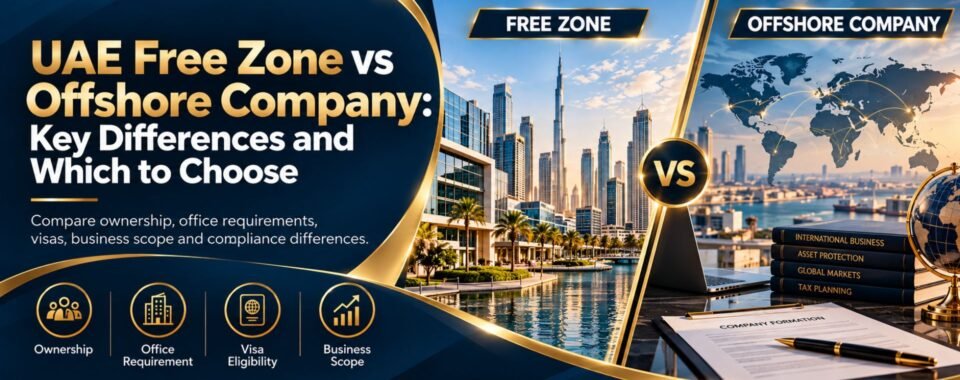
A UAE free zone company holds a trade licence, can lease an office, sponsor residence visas and operate from the UAE. A UAE offshore company, registered with RAK ICC or JAFZA, receives a certificate of incorporation instead, cannot trade with people inside the UAE, and is used mainly for holding shares, property and international business. Choose free zone for operations, offshore for holding.
Almost every international investor I meet asks the same question early on: “Should I set up a free zone company or an offshore company?” The two sound similar, both offer 100% foreign ownership, and both are registered in the UAE. But they are built for completely different jobs.
Choosing the wrong one is costly. An offshore company cannot get you a residence visa through a trade licence, and a free zone company may be more than you need for a simple holding structure. This guide explains the real differences using official registry and government sources, so you can choose the right structure the first time.
UAE Free Zone Company vs Offshore Company: The Core Difference
The simplest way to think about it: a free zone company is an operating business; an offshore company is a holding vehicle.
| Factor | Free zone company | Offshore company |
|---|---|---|
| Registration document | Trade licence | Certificate of incorporation (no business licence) |
| Examples | IFZA, Meydan, DMCC, RAKEZ, JAFZA (onshore) | RAK ICC, JAFZA Offshore, Ajman Offshore |
| Physical office | Required (flexi desk to full office) | Not required; registered office via a registered agent |
| Trade with people in the UAE | Within the free zone and internationally; mainland through distributors or extra licences | Not permitted |
| Residence visas | Yes, linked to the licence and office | Generally no, because there is no trade licence or premises |
| UAE bank account | Yes, subject to bank checks | Possible, but banks apply stricter checks |
| Typical use | Trading, consulting, tech, services | Holding shares, property, IP, international trade |
| Corporate tax | Within UAE corporate tax; 0% possible on qualifying income | Within UAE corporate tax rules for UAE-incorporated entities |
Offshore does not mean hidden. UAE offshore companies are registered with government registries such as RAK ICC and JAFZA, must act through an approved registered agent, and banks apply full know-your-customer checks on beneficial owners. Treat offshore as a legitimate, transparent holding structure, not a secrecy tool.
Free Zone Company: Trading, Service, With UAE Address
A free zone company is licensed to operate. Depending on the zone, you can trade goods, provide services, hire staff and sponsor residence visas.
What you get:
- A trade licence listing your approved activities
- A UAE address through a flexi desk, co-working space, office or warehouse
- Eligibility for investor, employee and dependent residence visas
- A strong basis for opening a UAE corporate bank account
- Access to the Qualifying Free Zone Person regime for corporate tax
Popular options: IFZA and Meydan for Dubai-based service businesses, DMCC for commodity trading, RAKEZ for low-cost and industrial setups, and JAFZA for import and export. For a full walkthrough, see our free zone company setup guide, or zone-specific guides for IFZA company formation and RAKEZ company formation.
Mainland note: free zone companies generally sell to the UAE mainland through a local distributor or by adding a mainland licence. If most of your customers are onshore, compare our mainland company formation in Dubai guide too.
Offshore Company: Holding, Assets, No UAE Trading
An offshore company is a corporate vehicle for owning and managing assets, not for running a UAE business.
What JAFZA says about its offshore companies (JAFZA):
- “A Jafza offshore company is not issued with a business licence, only a certificate of incorporation.”
- It “cannot conduct any commercial activity with persons within the United Arab Emirates”, but can operate internationally
- You must appoint a registered agent, and need at least one shareholder, one director and one secretary
- Common uses include holding companies, real estate ownership, international trade and IP registration (JAFZA guide)
RAK ICC, the Ras Al Khaimah government registry, reports 40,000 incorporations from 160 nationalities and offers companies limited by shares, holding companies, IP holding companies, foundations and more (RAK ICC). It also offers a separate “Global Product”, which it describes as a midshore free zone company with office options and residence visa eligibility (RAK ICC Global Product). That is useful if you start offshore and later need substance.
Can offshore companies hold Dubai property? Yes, in certain cases. JAFZA lists real estate ownership as a core use, and RAK ICC has published a Dubai Land Department agreement allowing registered RAK ICC companies to register freehold property in Dubai. For structuring ideas, see our guides on how to start a holding company in Dubai and Ajman Offshore.
Cost: Free Zone vs Offshore Fees
Free zone companies have published entry prices in several zones:
- RAKEZ: from AED 6,000, or AED 14,000 a year with one residence visa (RAKEZ)
- Meydan Free Zone: licence from AED 12,500 with a flexi desk (Meydan)
- IFZA: partners commonly quote zero-visa packages from about AED 12,900
On top of the licence, budget for the establishment card, visas, medicals, Emirates ID and any office upgrade.
Offshore companies do not usually publish all-in prices. RAK ICC describes its fees as “cost efficient”, and JAFZA directs applicants to its cost calculator. In practice, you pay a registry fee plus your registered agent’s fee, with no office rent or visa costs. Ask agents for a written quote covering incorporation, the first annual renewal and registered office.
The real comparison: offshore is usually cheaper to run each year, because there is no office and no visa. But if you need to live in the UAE or hire staff, you will need a free zone or mainland company anyway, so compare the total structure, not just one entity.
Corporate tax: the Federal Tax Authority treats juridical persons incorporated under UAE laws, including free zone regulations, as UAE resident for corporate tax (FTA). Older articles describe offshore companies as fully tax-exempt; check how corporate tax applies to your structure. See our corporate tax services and our guide to corporate tax for non-residents in the UAE.
Bank Account: Can Offshore Companies Open UAE Accounts?
Yes, but it is harder than for a free zone company.
- JAFZA states that its offshore companies can open a corporate account with a UAE bank or a bank abroad, in the currency of their choice
- RAK ICC lists the “ability to open bank accounts locally and internationally” as a benefit
Why banks are stricter with offshore companies:
- No trade licence or physical office in the UAE
- Often no UAE-resident director or shareholder
- Banks must understand the source of funds and the purpose of the structure
Tips from practice: prepare a clear structure chart, proof of the assets the company will hold, shareholder IDs, proof of address and a short business rationale. A UAE-resident shareholder or director often helps. For more, see our corporate bank account opening service and our guide to non-resident bank accounts in the UAE.
Visas: Free Zone Has Them; Offshore Does Not
This is the deciding factor for most people.
Free zone company: your licence and workspace give you a visa allocation for yourself (investor visa), employees and dependants. See our guide on the UAE investor visa.
Offshore company: a pure offshore company has no trade licence and no UAE premises, so it does not provide residence visas in the way a free zone company does. If you need a visa, you can:
- Set up a free zone or mainland company alongside the offshore holding company
- Use a product such as RAK ICC’s Global Product, which RAK ICC says provides residence visa eligibility
- Qualify for a visa through another route, such as employment or a Golden Visa
When to Choose Each Structure
| Your goal | Choose | Why |
|---|---|---|
| Live in the UAE and run a business | Free zone company | Trade licence, office and visas |
| Hire staff in the UAE | Free zone (or mainland) company | Visa allocation and premises |
| Hold shares in other companies | Offshore company | Low cost, no office needed |
| Own Dubai freehold property in a company | Offshore company (JAFZA or RAK ICC) | Property holding is a recognised use |
| Trade internationally without a UAE presence | Offshore company | Can operate internationally, not with UAE persons |
| Both operations and asset protection | Offshore holding plus free zone operating company | Separates risk and keeps visas |
My advice: many clients end up with both: an offshore or financial free zone holding company at the top, and a free zone operating company underneath. For premium holding options, see our guide on how to set up a DIFC holding company, or talk to our team about offshore company formation in Dubai and wider business setup in Dubai.
FAQs
What is the main difference between a UAE free zone and an offshore company?
A free zone company holds a trade licence, can lease an office, sponsor visas and operate from the UAE. An offshore company receives a certificate of incorporation, cannot trade with people inside the UAE, and is mainly used for holding assets and international business.
Can an offshore company get a UAE residence visa?
A pure offshore company does not have a trade licence or UAE premises, so it does not provide residence visas like a free zone company. Many investors pair an offshore holding company with a free zone operating company to get visas.
Can a UAE offshore company open a bank account?
Yes. JAFZA and RAK ICC both state that their offshore companies can open bank accounts, but banks apply stricter due diligence, so prepare clear documents on ownership, source of funds and purpose.
Is a UAE offshore company tax-free?
Not automatically. The UAE introduced corporate tax, and the Federal Tax Authority treats juridical persons incorporated under UAE laws, including free zone regulations, as UAE resident. Take tax advice on how the rules apply to your offshore structure.
Can an offshore company own property in Dubai?
In many cases, yes. JAFZA lists real estate ownership as a core use of its offshore companies, and RAK ICC companies can register Dubai freehold property under a Dubai Land Department agreement, subject to conditions.
Is an offshore company anonymous?
No. UAE offshore companies are registered with government registries, act through approved registered agents, and banks check their beneficial owners. Offshore is a transparent holding structure, not a secrecy tool.
Which is cheaper, a free zone or an offshore company?
Offshore is usually cheaper each year because there is no office or visa. Free zone licences start from about AED 6,000 to AED 12,900, depending on the zone, with visas and office costs on top.