


Summary
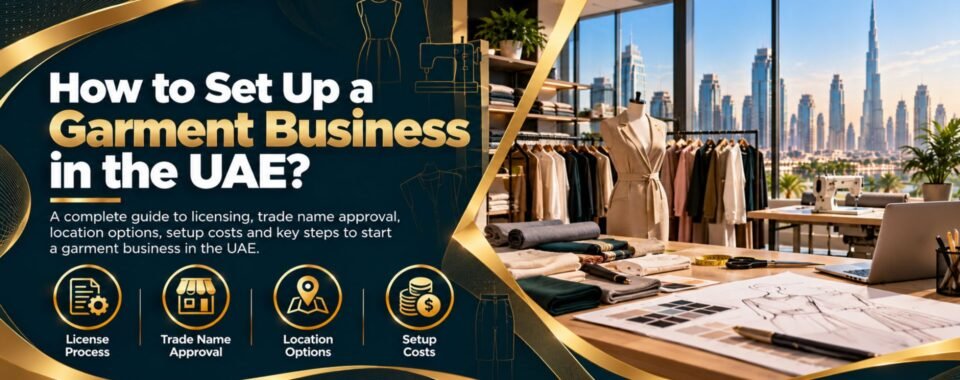
To set up a garment business in the UAE, first decide whether you will trade, retail, sell online, tailor or manufacture clothing. That choice decides your license: a trading or commercial license, an e-commerce license, or an industrial license for a garment factory. Most trading setups cost AED 25,000 to 75,000, while manufacturing needs far more. This guide covers activities, free zones, customs, costs and FAQs.
What Is a Garment Business?
A garment business covers any company that designs, makes, imports, sells or repairs clothing. In the UAE, that includes readymade garments trading, fashion retail, online clothing brands, tailoring and alteration shops, and textile or clothing manufacturing units.
The UAE is a natural base for the fashion trade. Dubai’s ports and airports connect suppliers in Asia with buyers across the GCC, Africa and Europe, and the local market spends heavily on fashion, modest wear and luxury labels.
If you are still comparing sectors, explore our wider business setup in Dubai services.
Types of Garment Businesses and the License Each Needs
| Business Model | License Type | Best Jurisdiction |
|---|---|---|
| Readymade garments trading (import, wholesale) | Trading license | Free zone or mainland |
| Clothing shop or boutique | Commercial license | Mainland |
| Online clothing brand | E-commerce license | Free zone or mainland |
| Tailoring, alterations and garment repair | Commercial license with workshop approval | Mainland |
| Fashion design consultancy | Professional license | Free zone or mainland |
| Textile or clothing manufacturing | Industrial license | Industrial zone or industrial free zone |
Each model has its own detailed guide on our site:
- Tailoring business license in Dubai
- Fashion boutiques and designer stores license
- How to start an online clothing brand in Dubai
- General trading license in Dubai
Textile and Clothing Manufacturing Business Setup
Manufacturing is the most capital heavy model, and it needs an industrial license, not a trading license. In Dubai mainland, the Department of Economy and Tourism (DET) issues industrial licenses. Free zones with industrial plots, such as JAFZA, Dubai Industrial City, the Ajman Free Zone and SAIF Zone, issue their own.
What a garment factory usually needs:
- A factory or workshop in an approved industrial area
- Machinery list and production layout
- Civil Defence and environmental approvals
- Labour accommodation plan for production staff
- Registration with the Ministry of Industry and Advanced Technology (MoIAT) for larger factories that want access to industrial incentives
Small cut and sew units, private label production and uniform manufacturing often start in Ajman or Sharjah, where industrial space costs less than in Dubai.
Readymade Garments Trading Business in Dubai
Most investors start here. A trading license lets you import clothing, store it, and sell to retailers or online buyers.
- Free zone trading: ideal for import, re-export and wholesale. Goods stored inside the zone are duty free until they enter the local market.
- Mainland trading: needed to sell directly to UAE shops and customers without a distributor.
- General trading: allows multiple unrelated product lines, useful if you plan to add footwear, bags or accessories.
If you need storage, read our guide to the warehouse license in Dubai.
Tailoring, Garment Repair and Fashion Design
- Tailoring and alterations: ladies gowns, abayas, suits and garment repair shops need a commercial license with a tailoring activity and a Municipality approved workshop.
- Fashion design consultancy: a professional license for designers who create collections, advise brands or work freelance. It suits a free zone or a small mainland office.
- Design to production: many designers license as a consultancy first, then add trading or manufacturing as orders grow.
Is a Garment Business Profitable in the UAE?
Yes, when you pick a clear niche and control stock. Fashion margins are healthy, but unsold inventory can wipe out profit quickly. The models that perform best for our clients are:
- Modest fashion and abayas: strong local and GCC demand all year
- Uniforms and workwear: steady B2B contracts with hotels, schools and contractors
- Private label for online brands: low inventory risk with made-to-order runs
- Readymade garments wholesale: high volume re-export to Africa and Central Asia
Seasonal peaks around Ramadan, Eid, Dubai Shopping Festival and back to school drive a large share of yearly sales, so plan stock and cash flow around them.
Sourcing and Supply Chain Tips
- Work with two or three suppliers per product line to avoid delays
- Order samples and inspect quality before placing bulk orders
- Agree clear Incoterms so you know who pays freight, insurance and duty
- Keep size ratios and reorder points in your inventory system
- Use a free zone warehouse to hold stock duty free and ship regionally
Mainland or Free Zone for a Garment Business?
| Factor | Mainland (DET) | Free Zone |
|---|---|---|
| Sell to UAE shops and walk-in customers | Yes, directly | Through a distributor or mainland branch |
| Import and re-export | Yes | Yes, with duty suspended inside the zone |
| Physical shop in malls or streets | Yes | No |
| Ownership | 100% for most activities | 100% |
| Best fit | Retail, tailoring, local wholesale | Trading, e-commerce, manufacturing, export |
For mainland setup, see our mainland company formation in Dubai guide. For an export-led brand, Dubai South and JAFZA are strong logistics choices.
How to Set Up a Garment Business in the UAE: Step by Step
- Choose your business model. Trading, retail, online, tailoring, design or manufacturing.
- Select the jurisdiction. Mainland, a trading free zone or an industrial zone.
- Pick the legal structure. Sole establishment, LLC or free zone company.
- Reserve a trade name and apply for initial approval.
- Secure premises. Office, shop, warehouse or factory, with Ejari for mainland.
- Get external approvals. Municipality for workshops, Civil Defence for factories and stores.
- Collect your trade license.
- Register with customs to get an importer code from Dubai Customs or the relevant emirate.
- Open a corporate bank account and apply for staff visas.
- Register your brand. File a trademark for clothing to protect your label.
Trading and e-commerce licenses can be ready in one to two weeks. Industrial licenses take longer because of factory approvals.
Documents Required
- Passport copies and photos of shareholders
- Emirates ID and visa copies for UAE residents
- Business plan with product range and target market
- Trade name reservation and initial approval
- Tenancy contract and Ejari for mainland premises
- Factory layout and machinery list for manufacturing
- Attested corporate documents if a company is the shareholder
Customs, Labelling and Import Rules
- Customs duty: most clothing imported into the UAE mainland pays 5% customs duty on the CIF value. Goods kept inside a free zone are not charged until they enter the local market.
- Re-export: goods re-exported from a free zone usually avoid UAE duty altogether.
- Labelling: garments sold in the UAE should show fibre composition, country of origin, care instructions and importer details, ideally in Arabic and English.
- HS codes: classify each product correctly to avoid customs delays.
Cost of Setting Up a Garment Business in the UAE
The ranges below reflect recent client projects and current market quotes. Always confirm current fees before you budget.
| Cost Item | Approximate Range (AED) |
|---|---|
| Free zone trading or e-commerce license | 10,000 to 20,000 per year |
| Mainland commercial license | 15,000 to 25,000 per year |
| Industrial license for a garment factory | 20,000 to 40,000 per year |
| Shop or office rent | 15,000 to 150,000 per year |
| Factory or workshop rent | 60,000 to 300,000 per year |
| Visas per employee | 3,500 to 7,500 |
| Trademark registration | Around 6,000 to 10,000 per class |
| Trading or online setup total | 25,000 to 75,000 |
| Small manufacturing unit total | 200,000 to 600,000+ including machinery |
For more fee details, see our guide to the cost of obtaining a trade license in Dubai.
VAT and Corporate Tax
- VAT: clothing sales carry 5% VAT. Register with the Federal Tax Authority once taxable sales pass AED 375,000 a year. Our VAT and tax consultancy team can handle it.
- Corporate tax: 9% applies to taxable profit above AED 375,000. Qualifying free zone income can be taxed at 0% if conditions are met. See our corporate tax services.
Common Mistakes to Avoid
- Taking a trading license when you actually plan to manufacture
- Opening a free zone company and then trying to sell to local shops directly
- Ignoring customs codes and labelling rules on the first shipment
- Launching a brand without registering the trademark
- Underestimating stock and working capital for seasonal collections
Expert Tip From Our Consultants
Start with the model that proves demand at the lowest cost. Many successful fashion brands in the UAE begin as an online store or trading company, outsource production, and only open a factory once orders are steady. If you plan to sell in malls later, add a mainland license at that stage. Planning to manage the business from Dubai? Ask us about the UAE investor visa.
Frequently Asked Questions
What license do I need to start a garment business in Dubai?
It depends on the model. Trading needs a trading license, a shop needs a commercial license, online sales need an e-commerce license and manufacturing needs an industrial license.
How much does it cost to start a clothing business in Dubai?
A trading or online clothing business usually costs AED 25,000 to 75,000 to set up. Retail stores and factories cost much more because of rent, stock and equipment.
Can I manufacture clothes in Dubai?
Yes, with an industrial license and a factory in an approved industrial area or industrial free zone.
Do I need a local sponsor for a garment business?
No. Most garment activities allow 100% foreign ownership on mainland and in free zones.
Is customs duty charged on imported clothes in the UAE?
Most clothing entering the mainland pays 5% customs duty on the CIF value. Goods kept in or re-exported from a free zone are generally exempt.
Can I sell clothes online with a garment trading license?
You usually need an e-commerce activity for online sales. See our e-commerce license guide.
Can I open a tailoring or garment repair shop?
Yes, with a mainland commercial license that includes tailoring or alterations and a Municipality approved workshop.
What is the best free zone for a garment business?
For trading and export, JAFZA, Dubai South and Ajman Free Zone are popular. For manufacturing, choose an industrial zone with factory plots.
Start Your Garment Business With Expert Support
Gulf Corporate Services helps fashion entrepreneurs, traders and manufacturers set up across the UAE. We handle license selection, free zone or mainland registration, customs codes, visas, banking and tax. Speak to our business setup consultants for a free cost estimate today.