



By Adil Ahmad, Business Setup Consultant at Gulf Corporate Services
Summary
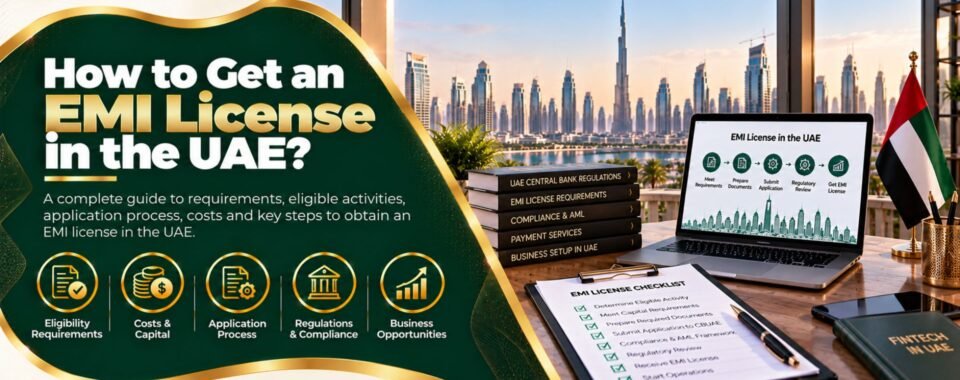
An EMI license in the UAE lets a company issue electronic money, run digital wallets and offer prepaid cards. Onshore, the Central Bank of the UAE regulates this activity as a Stored Value Facility (SVF), with minimum paid-up capital of AED 15 million. In DIFC and ADGM, the DFSA and FSRA license e-money and payment firms. Expect 9 to 15 months. This guide covers requirements, costs and FAQs.
What Is an EMI License?
An Electronic Money Institution (EMI) is a company licensed to issue electronic money, meaning stored monetary value that customers load in advance and then spend, send or withdraw. In Europe, the term “EMI licence” is standard. In the UAE, the same business is usually licensed under different names:
- Stored Value Facility (SVF) licence from the Central Bank of the UAE for onshore e-wallets and prepaid products
- Retail payment services licence from the Central Bank for payment initiation, merchant acquiring, transfers and related services
- Money services or stored value permissions from the DFSA in DIFC or the FSRA in ADGM
So when founders search for an “EMI license in Dubai” or “e-money license UAE”, the right answer depends on what product they want to offer and where their customers are.
Who Needs an EMI or SVF Licence?
- Digital wallet providers offering top-up, payments and peer-to-peer transfers
- Prepaid card issuers for consumers, payroll or travel
- Fintechs and neobanks that hold customer funds without a banking licence
- Super apps and marketplaces storing customer balances
- Remittance and cross-border payment companies that hold funds before transfer
If you only process payments for merchants without holding customer funds, a retail payment services licence may be enough. For crypto based products, see our guide to Dubai crypto exchange regulations.
Why Get an EMI or E-Money License in the UAE?
- Cash light economy: UAE residents use cards, wallets and contactless payments every day
- Large remittance market: millions of expatriates send money home regularly
- Clear regulatory frameworks from the Central Bank, DFSA and FSRA
- Regional gateway to the GCC, Africa and South Asia
- Strong investor interest in regulated fintech
UAE Regulators for E-Money and Payments
| Regulator | Where It Applies | Licence for E-Money | Notes |
|---|---|---|---|
| Central Bank of the UAE (CBUAE) | Mainland and non-financial free zones | SVF licence | Needed to serve UAE retail customers onshore |
| CBUAE | Mainland and non-financial free zones | Retail payment services licence | For payment services that do not issue stored value |
| Dubai Financial Services Authority (DFSA) | DIFC | Providing money services, including stored value | Mainly for business inside or from DIFC |
| Financial Services Regulatory Authority (FSRA) | ADGM | Providing money services, including stored value | Mainly for business inside or from ADGM |
The CBUAE rules are published in the CBUAE Rulebook. The UAE also issued a new Central Bank law in 2025, so confirm the current licensing framework before you apply.
SVF Licence Requirements (Onshore UAE EMI)
Based on the CBUAE Stored Value Facilities Regulation, key requirements include:
- Legal entity: a company incorporated in the UAE mainland or a non-financial free zone. Banks are generally exempt but must notify the CBUAE
- Minimum paid-up capital: AED 15 million
- Aggregate capital: at least 5% of the customer float, maintained at all times
- Bank guarantee: an unconditional guarantee for the paid-up capital
- Float safeguarding: customer funds protected and always redeemable
- Fit and proper owners and managers: board, senior management and controlling shareholders approved by the CBUAE
- Data in the UAE: customer and transaction data stored in the country
- Strong systems: risk management, internal controls, cyber security and AML/CFT programmes
- Independent assessment: a readiness review by an external assessor
SVF types range from closed loop (usable only with the issuer) and limited purpose to open loop wallets with peer to peer transfers. Open loop products face the heaviest requirements.
Retail Payment Services Licence
If you do not issue stored value, a retail payment services licence may fit. It covers activities such as merchant acquiring, payment accounts, domestic and cross-border transfers, payment aggregation and payment initiation. Capital requirements are lower than for SVF and depend on the licence category and services, often from around AED 500,000 to AED 2 million.
UAE EMI vs European EMI Licences
Many founders compare the UAE with EU EMI licences, for example in Lithuania, Cyprus or Montenegro. Key differences:
- An EU EMI licence can be passported across the European Economic Area. A UAE licence covers the UAE only
- EU EMI capital starts at EUR 350,000, while a UAE SVF licence needs AED 15 million paid-up capital
- The UAE gives direct access to Gulf customers, remittance corridors and local banking partners
Many groups hold both: an EU EMI for Europe and a UAE licence or partnership for the Gulf.
How to Get an EMI License in the UAE: Step by Step
- Define your product: wallet, prepaid card, payments or remittance, and who your customers are.
- Choose the regulator: CBUAE for onshore retail customers, or DFSA or FSRA for financial free zone models.
- Hold a pre-application meeting with the regulator.
- Set up the legal entity, for example through mainland company formation in Dubai, a free zone, or a DIFC or ADGM company.
- Prepare the application: business plan, financial projections, ownership chart, policies and technology documents.
- Appoint key people: CEO, compliance officer, MLRO, risk and finance heads.
- Submit and respond to regulator questions.
- Receive in-principle approval and build operational readiness.
- Inject capital, provide guarantees and complete the independent assessment.
- Receive the final licence and launch.
Well prepared CBUAE applications often take 9 to 15 months. DFSA and FSRA timelines depend on the business model and can be shorter for narrow permissions.
Documents Required
- Detailed business plan and three to five year financial projections
- Shareholder and ultimate beneficial owner information
- CVs and fit and proper declarations for directors and key staff
- AML, CFT and sanctions policies
- Risk management and internal control framework
- Safeguarding arrangements for customer funds
- IT architecture, cyber security and data protection documents
- Outsourcing and partnership agreements, such as banks and card schemes
- Audited financial statements of corporate shareholders
EMI License Cost in the UAE
The figures below are approximate. Regulatory capital is set by the rules, while other costs are market estimates. Always confirm current fees before budgeting.
| Cost Item | Approximate Cost (AED) |
|---|---|
| SVF minimum paid-up capital | 15,000,000 |
| Retail payment services capital | Around 500,000 to 2,000,000, by category |
| Regulator application and licence fees | Varies by regulator and activity |
| Company formation and office | 50,000 to 300,000 per year |
| Legal, compliance and application support | 200,000 to 1,000,000 |
| Technology platform and security | 500,000 to several million |
| Independent assessment and audit | 100,000 to 300,000 |
| Key staff salaries (first year) | 1,500,000 to 4,000,000+ |
Budget well beyond the minimum capital. Regulators expect enough funding to run the business until it becomes profitable. For financial free zone fees, see how much it costs to set up a business in DIFC.
Working With Banks and Card Schemes
No e-money business runs alone. You will need a safeguarding bank, settlement accounts and often a card scheme sponsor. Banks review your licence, ownership, AML controls and expected volumes before onboarding you. Digital banks such as Wio have changed how startups bank in the UAE, but regulated fintechs still face deeper checks. Founders based abroad can read about a non-resident bank account in the UAE, and teams adding digital asset features should review the crypto license in DIFC.
Ongoing Compliance
- Maintain capital and float safeguarding at all times
- File regular prudential and transaction reports
- Run AML checks, transaction monitoring and suspicious transaction reporting
- Keep customer data in the UAE where required
- Complete annual audits and regulatory inspections
Our accounting and financial reporting team can support audit readiness.
Tax for E-Money and Payment Companies
- Corporate tax: 9% on taxable profit above AED 375,000, with specific rules for free zone and financial free zone income. See our corporate tax services.
- VAT: many financial services are exempt, but fee based services are often standard rated at 5%. Check your position with the Federal Tax Authority or our VAT and tax consultancy team.
Common Mistakes to Avoid
- Choosing the wrong regulator for your customers
- Underestimating capital, salaries and time to approval
- Applying without senior compliance and risk staff in place
- Weak safeguarding and reconciliation of customer funds
- Assuming an EU EMI licence lets you serve UAE customers directly
Expert Tip From Our Consultants
Start with a clear product and customer map, then pick the licence that matches it. If your first version only processes payments, a retail payment services licence is faster and cheaper than an SVF licence. If you need a wallet, many fintechs launch through a partnership with a licensed bank or SVF provider while their own application is reviewed. Compare related routes in our financial advisory license in the UAE and forex trading license in the UAE guides.
Frequently Asked Questions
What is an EMI license in the UAE?
It is a licence to issue electronic money. Onshore, the Central Bank calls this a Stored Value Facility (SVF) licence.
How much capital do I need for an EMI license in the UAE?
An SVF licence needs at least AED 15 million paid-up capital. Retail payment licences need less, depending on the category.
How long does it take to get an EMI license in the UAE?
Usually 9 to 15 months for a CBUAE application. DIFC and ADGM timelines vary.
Can I get an EMI license in DIFC or ADGM?
Yes. The DFSA and FSRA license money services, including stored value, mainly for business conducted in or from those zones.
Can a foreign EMI operate in the UAE?
Not directly. Foreign EMIs need a UAE licence or a partnership with a licensed UAE institution.
What is the difference between an EMI and a payment service provider?
An EMI issues and holds electronic money. A payment service provider processes payments without storing value for customers.
Do I need a UAE bank account for an EMI?
Yes. You need corporate accounts for operations and safeguarding. Our bank account opening team can help.
How much does an EMI license cost in the UAE?
Beyond capital, most applicants budget several million dirhams for staff, technology, legal support and the first years of operation.
Start Your UAE EMI Licence Journey With Expert Support
Gulf Corporate Services helps fintech founders plan their UAE licensing route, form the right company, open bank accounts and prepare for regulator engagement. Explore our wider business setup in Dubai services, or speak to our business setup consultants for a tailored roadmap.