


By Adil Ahmad | Business Setup Consultant, Dubai Free Zones and Financial Services
Summary
DMCC and DIFC serve different businesses. DMCC is Dubai’s commodity and trade free zone, with 26,000+ companies, ecosystems for gold, diamonds, tea, coffee and energy, and the Tradeflow commodity platform. DIFC is Dubai’s financial centre, where financial services need DFSA authorisation under an English common law framework. Rule of thumb: commodity trading goes to DMCC, regulated financial services go to DIFC.
International clients often put DMCC and DIFC side by side because both are prestigious, both are in Dubai, and both attract serious money. But they are built for different jobs. One is a trading and commerce community. The other is a regulated financial centre with its own laws and courts.
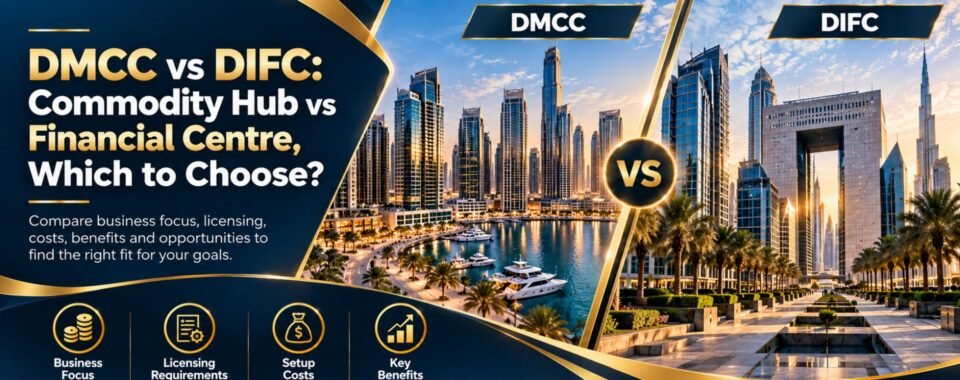
The question is not which is “better”. It is whether you trade goods or provide financial services. This DMCC vs DIFC comparison explains the difference using official sources, including cost, regulation and the cases where businesses use both.
DMCC vs DIFC: The Core Difference
| Factor | DMCC | DIFC |
|---|---|---|
| Full name | Dubai Multi Commodities Centre | Dubai International Financial Centre |
| Location | Jumeirah Lake Towers (JLT) and Uptown Dubai | Financial district on Sheikh Zayed Road |
| Core purpose | Commodity trade, commerce, tech | Regulated financial services |
| Legal framework | Free zone rules | Own civil and commercial laws on an English common law framework, with DIFC Courts |
| Financial regulator | Not a financial regulator | Dubai Financial Services Authority (DFSA) |
| Scale | 26,000+ member companies (2025) | 10,018 active companies (H1 2026) |
| Signature strength | Gold, diamonds, tea, coffee, energy; Tradeflow | Banking, wealth, funds, insurance, fintech |
| Entry packages | From about AED 29,000 to AED 50,000 (official) | Varies; Innovation Licence USD 1,500 a year; SPV USD 1,000 a year |
The simple rule: if you buy and sell physical goods, especially commodities, start with DMCC. If you manage money, advise on investments or run a regulated financial business, start with DIFC.
DMCC: Leading Free Zone for Commodities
DMCC was built around commodity trade and has grown into one of Dubai’s largest business communities. According to its 2025 results, DMCC has more than 26,000 member companies, welcomed over 2,300 new companies in 2025, and has over 3,600 companies in energy. DMCC also describes itself as a nine-time Global Free Zone of the Year winner.
DMCC’s commodity ecosystems (DMCC):
- Gold and precious metals, from refining to trading
- Diamonds and coloured gemstones through the Dubai Diamond Exchange
- Tea, coffee and cacao centres with processing and storage, including over 15,000 tonnes of tea and 8,200 tonnes of coffee processed in 2025
- Energy and agricultural commodities
- Crypto, AI and gaming centres, with over 1,000 companies combined
DMCC Tradeflow is a central registry of ownership for commodities stored in UAE warehouses, letting traders transfer or pledge title electronically for trade finance (DMCC Tradeflow). DMCC reports more than 296,000 Tradeflow Islamic transactions worth AED 1.32 trillion in 2025.
For setup details, see our DMCC free zone guide, and for specific commodities, read how to register a commodities trading company in Dubai and how to get a gold trading license in Dubai.
DIFC: The UAE’s Premier Financial Free Zone
DIFC was established in 2004 and operates its own civil and commercial laws on an English common law framework (About DIFC). According to its H1 2026 results:
- 10,018 active registered companies, up 30% year on year
- 1,134 regulated financial services firms
- 327 banking and capital markets firms and 592 wealth and asset management firms
- 165 insurance and reinsurance entities
- 1,933 AI, FinTech and innovation firms
- 1,409 foundations, up 67% year on year
What makes DIFC different: the DIFC Courts, an independent regulator, and structures designed for wealth and investment, such as SPVs, foundations and funds. Non-regulated innovation firms can use the DIFC Innovation Licence at USD 1,500 a year.
For costs and structures, see our guides on how much it costs to set up a business in DIFC, how to get a DIFC license and the DIFC Innovation Licence.
Cost: DMCC vs DIFC Annual Fees
DMCC packages (DMCC packages):
| DMCC package | Price | Includes |
|---|---|---|
| JLT Resident | AED 29,205 | Flexi desk, for JLT residents |
| Crypto, AI or Gaming Centre | AED 31,000 | Co-working, ecosystem access |
| Basic Biz | AED 35,484 | 1 visa, flexi desk, individual shareholders |
| Prime Plus (1 year) | AED 40,145 | Licence only, for medium and large companies |
| Jump Start | AED 43,780 to AED 49,941 | 1 visa, flexi desk or co-working |
DIFC costs depend heavily on your activity:
- Innovation Licence: USD 1,500 a year, subsidised for 2 to 5 years, for eligible tech and innovation firms
- SPV (holding vehicle): USD 100 incorporation and USD 1,000 a year (DIFC SPVs)
- Regulated financial firms: DFSA application and annual fees, capital requirements, compliance staff and a physical office, which together usually make DIFC the more expensive option for financial services
Bottom line: for a small trading company, DMCC packages are easier to budget. For a holding SPV or innovation start-up, DIFC can actually be cheaper. For a regulated financial firm, DIFC costs are higher but unavoidable.
Corporate tax: both are free zones under UAE corporate tax. Qualifying income may be taxed at 0% only if the company meets the Qualifying Free Zone Person conditions in the Federal Tax Authority guide. Other taxable income is taxed at 9%. See our trade license cost in Dubai guide for wider budgeting.
Regulation: DMCC Authority vs DFSA for Regulated Activities
This is where most confusion happens.
DIFC and the DFSA. The DFSA states that anyone conducting financial services in or from DIFC must be authorised by the DFSA. That covers banking, asset management, advisory, brokerage, insurance and more. Since 1 November 2022, the DFSA has also run a crypto token regime for DIFC firms.
DMCC. DMCC is a free zone authority that licenses companies; it is not a financial regulator. Activities that need financial regulation are licensed by the relevant UAE or Dubai regulator, not by DMCC itself. For example, virtual asset activities in Dubai outside DIFC fall under Dubai’s Virtual Assets Regulatory Authority (VARA), which Law No. 4 of 2022 applies across the emirate, including free zones, but not DIFC (UAE Government portal).
What this means in practice:
- Trading physical commodities: DMCC licence, no financial regulator needed
- Managing client money or advising on investments: DIFC with DFSA authorisation
- Crypto business: DMCC Crypto Centre with VARA licensing, or DIFC under the DFSA crypto token regime
For crypto specifically, see our guides to the cryptocurrency license in Dubai, the crypto license in DMCC and the crypto license in DIFC.
Who Should Choose DMCC vs DIFC?
| Your business | Choose | Why |
|---|---|---|
| Gold, diamond or precious metals trader | DMCC | Dedicated ecosystem and Dubai Diamond Exchange |
| Tea, coffee, agri or energy trader | DMCC | Processing centres and Tradeflow |
| Commodity trader needing inventory finance | DMCC | Tradeflow title registry |
| Asset manager, fund or broker | DIFC | DFSA authorisation required |
| Wealth manager or financial adviser | DIFC | Regulated advice under DFSA |
| Family office, holding SPV or foundation | DIFC | Common law structures and courts |
| Fintech or AI start-up | DIFC Innovation Licence or DMCC AI Centre | Both offer ecosystems; choose by regulation needs |
| Crypto company | DMCC Crypto Centre or DIFC | VARA vs DFSA regimes |
Many groups use both. A common structure is a DMCC trading company for physical commodity flows and a DIFC holding company or fund above it, combining DMCC’s trade ecosystem with DIFC’s legal framework. Read our guide on how to set up a DIFC holding company to see how this works, or talk to our team about free zone company setup and wider business setup in Dubai.
FAQs
What is the main difference between DMCC and DIFC?
DMCC is a commodity and trade free zone for physical goods, commerce and tech. DIFC is a financial centre with its own laws, courts and regulator, the DFSA, for banking, investment, insurance and other financial services.
Which is better for financial services, DMCC or DIFC?
DIFC. Financial services carried out in or from DIFC must be authorised by the DFSA, and DIFC’s legal framework is designed for regulated finance. DMCC is not a financial regulator.
Is DMCC regulated by the DFSA?
No. The DFSA regulates financial services in DIFC. DMCC is a free zone authority. Regulated activities in DMCC, such as virtual assets, fall under the relevant Dubai or UAE regulator, for example VARA for virtual assets.
Which is cheaper, DMCC or DIFC?
It depends. DMCC packages start from about AED 29,000 to AED 35,000. DIFC’s SPV licence costs USD 1,000 a year and its Innovation Licence USD 1,500 a year, but regulated financial firms in DIFC face much higher costs.
Can a company be set up in both DMCC and DIFC?
Yes. Many groups use a DMCC trading company for commodity operations and a DIFC holding company or fund for ownership and investment.
Where are DMCC and DIFC located?
DMCC is in Jumeirah Lake Towers and Uptown Dubai. DIFC is in Dubai’s financial district on Sheikh Zayed Road. They are separate districts, not neighbours.
Is DMCC good for crypto companies?
DMCC runs a Crypto Centre for crypto and Web3 firms. Virtual asset activities in Dubai outside DIFC must also be licensed by VARA, so plan for both.